


- Home

- Places
- Activities/Tours
- Foodies
- Hotels/Resorts
- Protected Areas
- Home
- Places
- Activities/Tours
- Foodies
- Hotels/Resorts
- Protected Areas
- Important Info
Now Reading: 20 Interesting Facts About ATM Belize
1-
01
20 Interesting Facts About ATM Belize
ATM Belize – 20 Interesting Facts about Actun Tunchil Muknal The Cave of the Stone Sepulchre
Deep within the lush rainforests of Belize lies a portal to another time. Actun Tunichil Muknal, or ATM Belize as it is widely known, is not merely a cave; it is a sacred resting place, a natural museum, and one of the most profound archaeological sites in the Maya world. To venture into its depths is to walk in the footsteps of ancient priests and to witness the solemn history of a civilisation grappling with existential challenges. This is a place of staggering beauty and sombre secrets, where nature and history are inextricably intertwined.
For those with a spirit of adventure and a reverence for the past, the ATM Belize cave offers an unparalleled experience. It is a physically demanding journey that rewards visitors with sights that have remained largely untouched for over a thousand years. From the moment one swims into its shadowed entrance to the final, breathtaking reveal of its ceremonial chambers, the cave commands respect. This article delves into 20 fascinating facts that illuminate the significance and mystery of ATM Belize, providing a comprehensive look into why this site is considered a jewel of Central American archaeology.
1. The Meaning Behind the Name
The name Actun Tunichil Muknal is a Mayan phrase that translates to “Cave of the Stone Sepulchre.” This evocative name was given to the cave due to the discovery of numerous skeletal remains within its chambers, interred in what the Maya considered a sacred, stone tomb. It perfectly captures the cave’s primary function as a ceremonial burial site.
2. A Relatively Recent Discovery
Despite being used by the Maya for centuries, the cave was lost to the outside world for over a millennium. It was rediscovered in 1989 by Canadian geologist Thomas Miller. Shortly after, renowned Belizean archaeologist Dr. Jaime Awe began the extensive research that would unveil the cave’s secrets, providing invaluable insights into the terminal phase of the Classic Maya period and making ATM Belize a crucial site for understanding this era.
3. Rated #1 Sacred Cave by National Geographic
The global significance of ATM Belize was cemented when National Geographic ranked it as the number one “Sacred Place of a Lifetime.” This prestigious recognition highlighted the cave’s unique combination of natural beauty, archaeological importance, and the sheer adventure required to explore it, placing ATM Belize firmly on the world map for cultural tourism.
4. The Journey is an Adventure in Itself
Visiting ATM Belize is not a simple walk-in tour. The experience begins with a 45-minute trek through the dense jungle of the Tapir Mountain Nature Reserve. This hike involves crossing the Roaring River three times, often in waist-deep water, before you even reach the cave’s entrance. This challenging approach weeds out casual tourists and ensures that visitors are truly committed to the experience.
5. You Must Swim to Enter
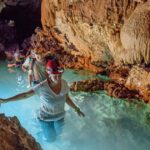
The entrance to ATM Belize is a small, hourglass-shaped opening at the base of a cliff. To enter this sacred underworld, visitors must take a leap of faith and swim across a deep, spring-fed pool for about 10 metres, holding their breath for a moment to pass under a rock overhang. This dramatic entrance feels like a true rite of passage, separating the outer world from the sacred space within.
6. A Living Museum with Over 1,400 Artefacts
Inside, ATM Belize is a veritable treasure trove. Archaeologists have catalogued more than 1,400 artefacts, all left exactly where they were found. These include ceramics, stoneware, and tools. Many of the pots are marked with a “kill hole,” a hole intentionally made to release the spirit of the object, a common practice in Mayan rituals.
7. The Famous “Crystal Maiden”
The most famous resident of ATM Belize is the “Crystal Maiden.” This is the complete skeleton of an individual, once thought to be a young woman, lying in the cave’s furthest chamber. Over centuries, the bones have been calcified by the dripping mineral water, giving them a sparkling, crystalline appearance. This hauntingly beautiful sight is the climax of the tour.
8. Not Just One, but 14 Skeletons
While the Crystal Maiden is the most celebrated, she is not alone. The remains of at least 14 other individuals have been discovered within ATM Belize. These include seven adults and seven children, all under the age of five. Their presence points to the cave’s extensive use for human sacrifice.
9. A Site of Human Sacrifice
The skeletal remains are the most direct evidence of the solemn rituals that took place here. It is believed the Maya turned to human sacrifice in desperate times. During the Terminal Classic period (around 700-900 AD), a severe and prolonged drought plagued the region. Archaeologists theorise that these sacrifices were offerings to Chaac, the Maya rain god, in a desperate plea to end the suffering.
10. The Skeletons Reveal a Brutal End
Many of the skeletons show signs of a violent death. Cranial trauma is evident on several skulls, suggesting they were bludgeoned. The position of the Crystal Maiden, with her spine crushed, indicates a particularly brutal end. This evidence provides a stark and sobering window into the desperation that the Maya civilisation faced.
11. Strict Preservation Rules are Enforced
To protect this fragile environment, the Belizean government enforces very strict rules. All tours into ATM Belize must be led by a specially licensed guide. The number of daily visitors is capped to minimise human impact, ensuring the site’s preservation for future generations.
12. No Cameras or Phones Allowed
A crucial rule for all visitors to ATM Belize is the complete ban on cameras, video recorders, and mobile phones. This rule was implemented after a tourist accidentally dropped a camera, fracturing one of the ancient skulls. The policy not only protects the artefacts but also encourages visitors to be fully present in the moment, absorbing the profound atmosphere of the cave without distraction.
13. Footwear is Forbidden in the Main Chamber
Upon reaching the upper dry chamber, known as “The Cathedral,” visitors are required to remove their shoes and proceed only in socks. This is to protect the delicate cave floor and the calcified artefacts from the oils, dirt, and bacteria carried on shoes. Walking in socks also forces a slower, more careful pace, increasing reverence for the sacred space.
14. A Geologically Active Wonder
ATM Belize is a wet cave, meaning water still flows through it, actively shaping its stunning geological formations. Visitors will navigate past colossal stalactites and stalagmites that have been growing for thousands of years. The interplay of water and limestone has created a breathtaking subterranean landscape that is as impressive as the archaeology it holds.
15. The Cave’s Chambers Represent the Underworld
For the ancient Maya, caves were seen as portals to Xibalba, the underworld. The layout of ATM Belize, with its progression from the watery entrance to the high, dry chambers, likely mirrored their cosmological beliefs. The deeper one ventured, the closer one came to the realm of the gods, making it the ideal location for powerful rituals.
16. Evidence of Elite Bloodletting Rituals
Beyond human sacrifice, ATM Belize was also a site for elite rituals. Archaeologists have found obsidian blades and stingray spines, objects used by Maya royalty and priests in bloodletting ceremonies. These painful acts were a way to communicate with the gods and were considered a sacred duty of the ruling class.
17. The Artefacts Tell a Story of Escalating Desperation
The placement of artefacts within ATM Belize suggests a pattern of increasing desperation. The earliest ceremonial objects are found closer to the cave entrance. As time went on, and the drought presumably worsened, the rituals moved deeper into the cave, and the sacrifices became more significant, culminating in the human offerings in the innermost chambers.
18. The “Monkey Pot” is a Unique Find
Among the many ceramic vessels is a particularly famous artefact known as the “Monkey Pot.” This pot is one of only four of its kind ever discovered in Belize. The image of a monkey on the vessel is significant in Maya cosmology, and its presence in such a sacred context underscores the importance of the rituals performed at ATM Belize.
19. A Challenging Environment for Archaeologists
The same conditions that make ATM Belize an adventure for tourists present significant challenges for researchers. The remote location, the need to swim and navigate tight passages, and the wet environment make excavation and documentation difficult. Much of the research has to be conducted with specialised underwater equipment, adding a layer of complexity to the study of this incredible site.
20. ATM Belize is a Protected Natural Reserve
The cave and its surrounding area are part of the Tapir Mountain Nature Reserve, a protected area of over 6,700 acres. This designation helps protect the watershed and the pristine jungle ecosystem that is vital for the preservation of the cave. The conservation efforts ensure that the entire environment surrounding ATM Belize remains intact, safeguarding both its natural and cultural heritage.
Share
Stay Informed With the Latest & Most Important News

Previous Post
Next Post
Previous Post
Next Post
DonationsAdvertisement
 Loading Next Post...Scroll to TopPopular Now
-
 01Discover Belize’s Hidden Gem – Cockscomb Basin Wildlife Sanctuary
 -
 02The Community Baboon Sanctuary: Unmasking the Primate Haven
 -
 03Xunantunich
 -
 04Belize All-Inclusive Resorts: Your Ultimate Guide to Paradise
 -
 05The Belize Barrier Reef: A UNESCO World Heritage Site
 -
 06The Best Time to Visit Belize: A Comprehensive Guide
 -
 07Belize Protected Areas: A Comprehensive Guide
- Activities/Tours
- Activities/Tours